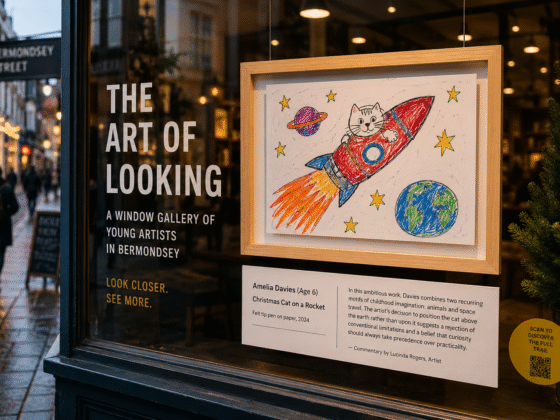
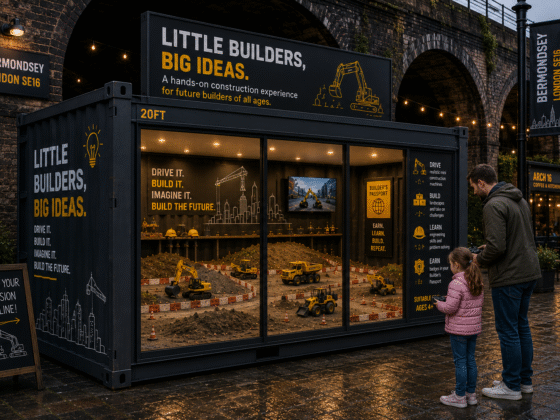
Bermondsey BID is pushing forward work with Southwark Council, local businesses, commercial property owners, residents and entrepreneurs to bring vacant commercial spaces back into use, particularly along Southwark Park Road, and help build a stronger, more distinctive local high street over the years ahead.
There is, unfortunately, no button marked “Fix High Street”.
If there were, local authorities across Britain would presumably have pressed it by now, possibly after commissioning a report (all large organisations private and public love this route).
Real high streets develop rather less conveniently.

One good business opens. Another follows. Somebody tries something nobody was expecting. An empty shop becomes a workshop. A café gives people a reason to stay for another half-hour. An event brings people down a road they normally pass by. Gradually, almost irritatingly slowly, those things start to add up.
It can take five or ten years.
We think Blue Bermondsey is worth taking that longer view.
Our immediate focus is Southwark Park Road and the surrounding Blue Bermondsey area. It is the neighbourhood’s traditional shopping street and, at present, also where some of the gaps in the high street are most obvious.

Empty shops are not good for anybody. They do not help the businesses next door, they do not make the street more inviting for residents and, unless vacant units have recently developed a surprising enthusiasm for paying business rates and buying coffee, they contribute very little to the local economy.
So we want to do something about them.
We are working with Southwark Council to explore how some of its vacant commercial units could find new uses and new occupiers.
It is early days. There is no enormous regeneration scheme about to descend from the sky, accompanied by architectural renderings of impossibly happy people cycling past ornamental grasses.

And that is probably a good thing.
What we do have is an opportunity to think more deliberately about what Southwark Park Road could become, and then start doing the smaller things that, over time, might actually get us there.
More than filling empty shops
Obviously, an occupied shop is generally preferable to an empty one.
But the ambition cannot simply be to achieve the maximum possible number of functioning door locks.
What matters is what happens inside those spaces and what that adds to everything around them.
We want Blue Bermondsey to develop as an experience and destination high street: somewhere that serves the people who live and work here, but also gives other people a reason to come, look around, stay for a while and perhaps spend some money while doing so.
That might mean shops.
But it could also mean food, workshops, studios, makers, galleries, services, social enterprises, co-operatives, community projects, entertainment or something none of us has thought of yet.
Indeed, we rather hope there are things none of us has thought of yet.
Because if the future of the high street is determined entirely by a group of people sitting around a table deciding what entrepreneurs ought to do, we have probably misunderstood entrepreneurship.
The interesting ideas tend to come from the people willing to try them.
Our job should be to help good ideas find a way through.

And, importantly, the businesses already here
It is very easy when talking about “the future of the high street” to accidentally give the impression that the high street does not currently contain anybody.
It does.
Southwark Park Road and the wider Blue Bermondsey area already have independent shops, family businesses, cafés, pubs, restaurants, workshops, services, makers and businesses whose owners have invested time, money and an unreasonable number of waking hours into trading here.
Any attempt to improve the high street needs to strengthen that existing economy, not behave as though we are starting with a blank sheet of paper.
The right new businesses can help.
Someone visiting a workshop may buy lunch nearby. Someone travelling across London for a specialist shop may notice another business next door. A gallery or evening activity can put people on the street at times when it would otherwise be quiet.
One business creates customers for another.
That is how a high street starts becoming more than a collection of individual premises.
The objective is not simply more businesses.
It is more reasons to be here.

What do we mean by a “destination”?
“Destination high street” is the sort of phrase that can understandably make people nervous.
It can conjure visions of somewhere becoming very fashionable indeed, followed shortly afterwards by the appearance of a shop selling six varieties of artisanal salt.
That is not what we mean.
Blue Bermondsey needs to work for the people who live here first.
A good local high street should let you buy useful things, have something repaired, meet someone, eat, drink, take children somewhere, discover something interesting or simply walk along a street that feels busy and looked after.
If doing those things well also makes somebody from another part of London think, “Actually, let’s go to Southwark Park Road,” excellent.
Those visitors help support businesses.
But becoming a destination should mean making more of what is distinctive about the neighbourhood, not replacing it with something imported from elsewhere.
So, rather than deciding everything ourselves…
We want to hear from people with ideas.
We have opened a simple expression-of-interest process for entrepreneurs, start-ups, independent businesses, co-operatives, makers, creatives, community organisations and anyone else who thinks they could do something interesting with an empty commercial space.
And we really do mean simple.
You do not need to produce a 46-page business plan containing a graph showing optimistic growth disappearing attractively towards the top-right corner (you can if you want, but every entrepreneur who’s had a go knows that’s not how things go).
We want enough information to know that you have thought about your idea.
What would you like to do?
Who is behind it?
What sort of space might you need?
How far have you got?
And, crucially:
What is stopping you?
Because “what is stopping you?” may be the useful bit
Bermondsey BID does not currently have a dedicated pot of money to fund these ideas (but we can lean on people).
It would obviously be more exciting if this paragraph announced several million pounds and a man standing nearby with an enormous ceremonial cheque, but it does not.
We think it is better to be clear about that.
What we can do is start finding out why viable ideas are not becoming businesses.
Perhaps somebody has the experience, customers and £20,000 to invest but cannot find an appropriate space.
Perhaps they can afford the rent but not the deposit and fit-out simultaneously.
Perhaps a potentially excellent food business discovers that extraction costs make the numbers impossible.
Perhaps somebody needs relatively little money but a great deal of help navigating planning, licensing or finance.
One application tells us about one project.
Twenty or thirty applications may start telling us something about the system.
If the same barrier keeps appearing, we can begin asking whether there is something Blue Bermondsey, Southwark Council or another partner could do about it.
We should understand the problems before inventing programmes intended to solve them.
It sounds obvious when written down.
This does not mean it always happens.
Show us rather than writing an essay
We are also very happy for people to show us what they mean.
Send us photographs. Drawings. Sketches. A moodboard. A website. An Instagram page. Photos of something you already operate. A deck. A prototype.
Or make a video.
In fact, a two-minute phone video of somebody standing in their kitchen, workshop or existing business saying, “Right, this is what I want to do…” can be considerably more useful than six pages of carefully formatted text.
It does not need lighting.
It does not need editing.
It certainly does not need inspirational background music.
We are interested in whether the idea is good, not whether you have accidentally become a television production company.
This is going to take a while
We should also manage expectations.
Not every idea will find a unit.
Not every empty property will be suitable.
Some ideas will turn out not to work. Others will change completely once people start looking at the practicalities.
Property, leases, planning, licensing, investment, construction costs and business viability all have a habit of interfering with elegant plans.
Which is why we see this as a five-to-ten-year project, not a six-month campaign followed by a press release declaring victory.
There should be successes much sooner than that.
But creating a genuinely stronger high street means gradually developing a better mix of businesses, reducing vacancies, bringing more people into the area and establishing a reputation that encourages still more people to take a chance on it.
Success builds on success.
Unfortunately, so does failure.
The point is to get that cycle moving in the right direction.
Something we have to do together
Bermondsey BID can push this work forward.
But we cannot manufacture a successful high street on our own.
Southwark Council has an important role, both as a local authority and as the owner of commercial property in the area.
Existing businesses know what trading here is actually like.
Residents know what the neighbourhood needs.
Entrepreneurs bring ideas, energy, and occasionally the sort of unreasonable determination required to open a business in the first place.
Bring those things together and we have a much better chance.
Blue Bermondsey does not need somebody to invent an identity for it.
It already has one.
There is history here. Industry. Making. Independent businesses. Established communities. New communities. Creativity. And quite a lot of people already doing interesting things without waiting for anyone to describe them as a “placemaking intervention”.
The opportunity is to build on that.
To get empty spaces back into use.
To make Southwark Park Road somewhere people choose to spend more time.
To strengthen the businesses that are already here.
And to give the next generation of good ideas a chance to become part of the neighbourhood.
It will take time.
But the next business that, in ten years’ time, everyone regards as an obvious part of Blue Bermondsey may currently consist of one person, an idea and a folder full of photographs.
If that sounds remotely like you, we’d like to hear from you.