Building on last years project, and learning some lessons from it also https://bermondsey.london/events/festive-windows/
This years the project will be even more community based. Turning Bermondsey’s Shop Windows into a Gallery of Young Artists (we need business owners, schools, nursery groups, artists, community groups etc please reach out, see email at the bottom).
Imagine walking down Southwark Park Road in Bermondsey on a cold December evening.
The Christmas lights are on. People are heading home from work. Others are meeting friends for dinner.
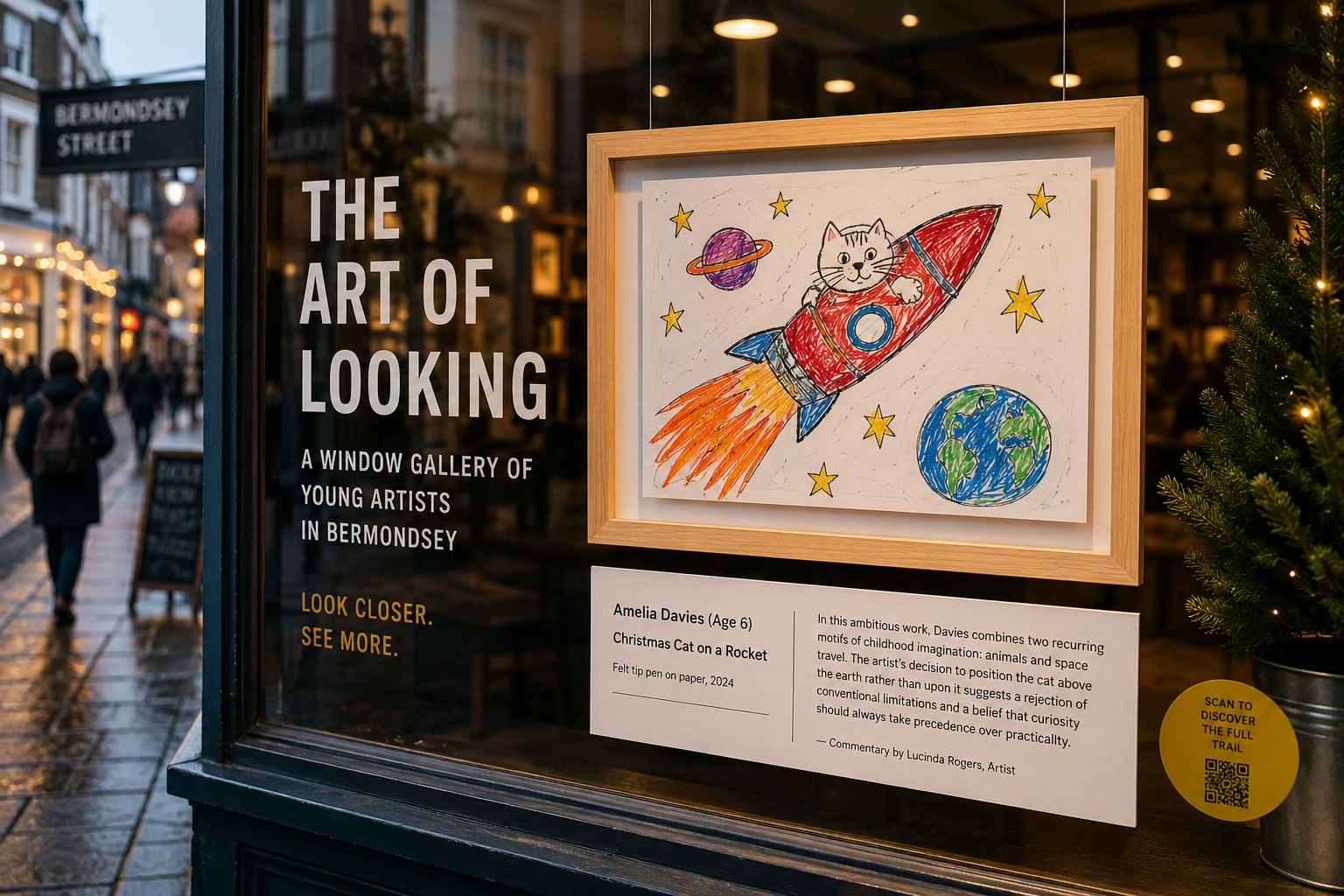
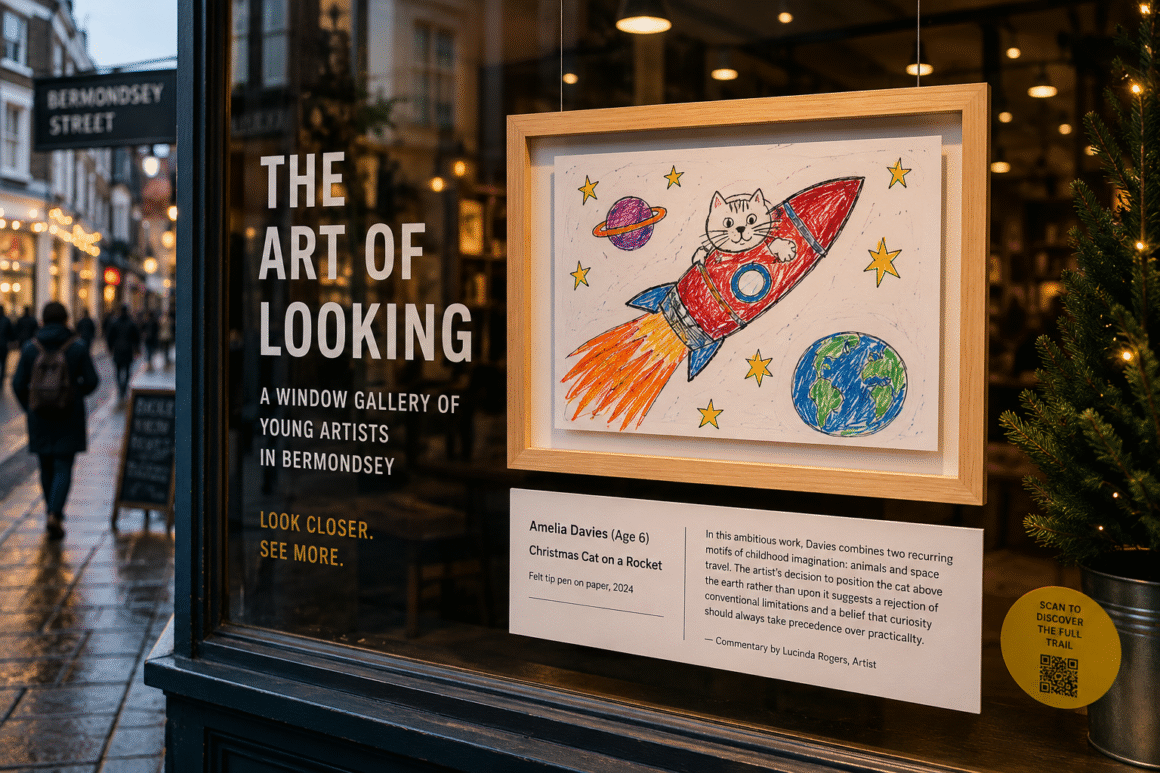
In the window of a local café, a single framed drawing hangs beneath a small gallery label.
The Flying Christmas Cat
Amelia, Age 6
Felt tip pen on paper
Beneath it, a short exhibition text reads:
“In this ambitious work, the artist explores themes of adventure, companionship and seasonal optimism. The decision to place the cat above the Earth rather than upon it suggests a rejection of conventional limitations and a belief that curiosity should always take precedence over practicality.”
You smile.
Not because it is ridiculous.
Because it is oddly true.
You look at the drawing again.
The cat does look determined.
The rocket does look joyful.
And suddenly you are spending more time looking at a child’s drawing than you normally would.
That is the point.
Every December, children’s drawings appear on classroom walls, fridge doors and kitchen noticeboards across the country. They are loved, displayed for a few weeks and then quietly packed away.
But what if we treated them differently?
What if we displayed them with the same care and attention normally reserved for works hanging in major galleries and museums?
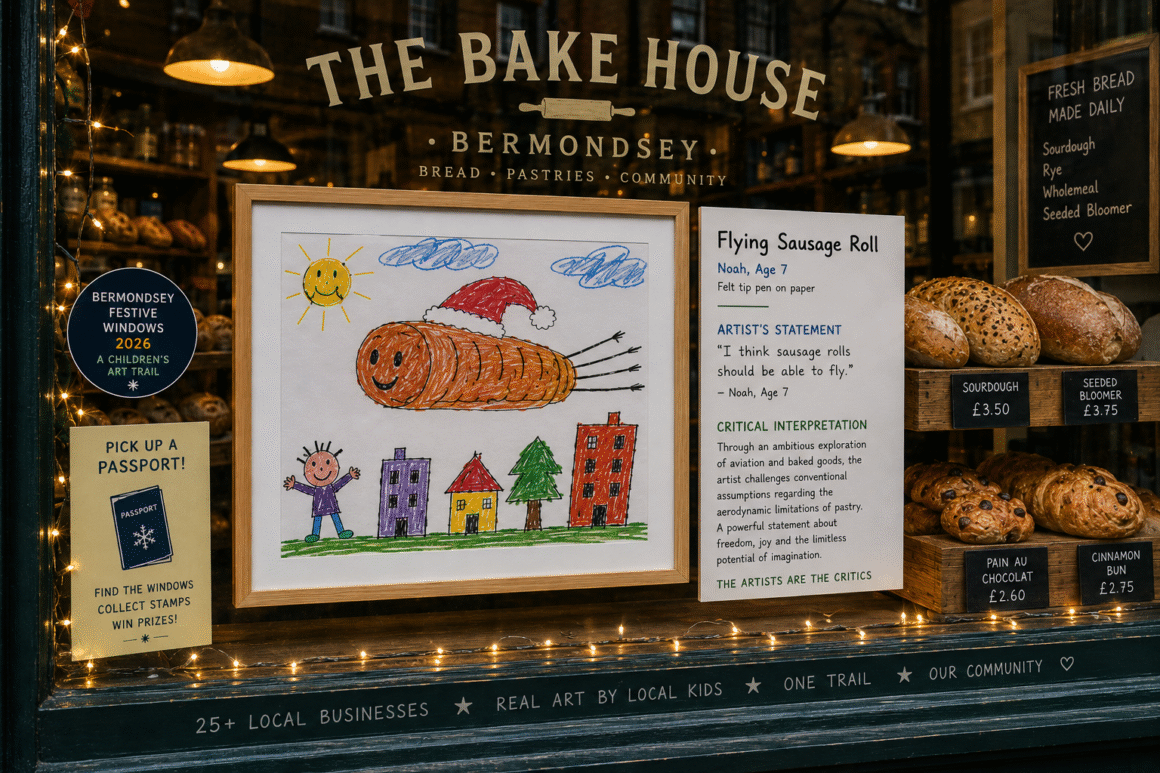
This year, Bermondsey’s businesses are exploring an idea that would transform shop windows across the neighbourhood into a distributed public gallery of children’s festive artwork (and non-festive work that they’re proud of).
Local schools, nurseries and community groups would invite children to create drawings. Rather than simply pinning them up in windows, each artwork would be professionally presented and accompanied by a thoughtful interpretation written by a local artist, writer, designer, architect, maker or creative practitioner.
The role of the adult is not to judge the work.
It is to look at it properly.
To spend time with it.
To take it seriously.
A drawing of Father Christmas arriving by speedboat at Greenland Dock might become a commentary on Bermondsey’s relationship with the river.
A Christmas tree balanced on top of The Shard could be interpreted as a playful exploration of scale and place.
A reindeer with eight different coloured legs might become an investigation into movement and celebration.
The interpretations would be playful, but sincere.
The aim is not to parody the art world.
The aim is to genuinely elevate the work.
Because children create some of the most original art in our communities.
Free from many of the assumptions adults accumulate over time, they approach creativity with curiosity, confidence and experimentation. They are less concerned about whether something is technically correct and more concerned with whether it is interesting.
Yet we rarely stop to look closely at what they create.
The project asks a simple question:
What changes when we decide something deserves our attention?
Imagine a family walking through Bermondsey on a Saturday afternoon, map in hand, following an art trail from window to window.
At one stop, a seven-year-old proudly points to her drawing in the window of a local bakery.
At another, grandparents stop to read an exhibition text outside a pub.
Further along the route, somebody who came out to buy coffee finds themselves studying a drawing of a snowman with twelve arms and discussing it with a complete stranger.
The exhibition would not take place in a gallery.
Bermondsey would become the gallery.
Cafés, restaurants, offices, workshops, independent shops and local businesses would each host artworks in their windows. Together they would create a festive trail that encourages residents and visitors to explore the area while celebrating the creativity already present within the community.
For children, it creates an unforgettable moment.
Most people never have an exhibition of their work.
Imagine being eight years old and seeing your drawing professionally displayed in a shop window while complete strangers stop to look at it.
Imagine bringing your parents, grandparents or friends to see it.
Imagine hearing someone discuss your work as though you were a real artist.
Because, of course, you are.
For businesses, it offers a meaningful way to participate in a community project while helping animate local streets during the festive period.
For local artists and creative practitioners, it provides an opportunity to contribute not by exhibiting their own work, but by helping others see creativity through fresh eyes.
And for Bermondsey as a whole, it creates something increasingly rare: a cultural experience that is free, accessible and rooted in local people.
This is exactly the kind of project that Bermondsey’s businesses can achieve when working together through their Business Improvement District, alongside local charity Big Local Works.
A BID allows local businesses to pool resources and invest collectively in the area they share.
No single business could turn an entire neighbourhood into a gallery.
Together, they can.
Together, they can provide the windows, the audience, the partnerships and the coordination needed to celebrate local creativity at a meaningful scale.
The result is a project that supports local businesses, celebrates local children, engages local artists and creates moments of surprise and delight throughout the neighbourhood.
A drawing that might otherwise spend a few weeks on a classroom wall becomes a public artwork.
A shop window becomes a gallery.
A local artist becomes a critic.
A child becomes an exhibiting artist.
And all because somebody took the time to stop, look closely and pay attention.
Get involved: Ben@Bermondsey.London
Update 1:
The Young Curator’s Passport
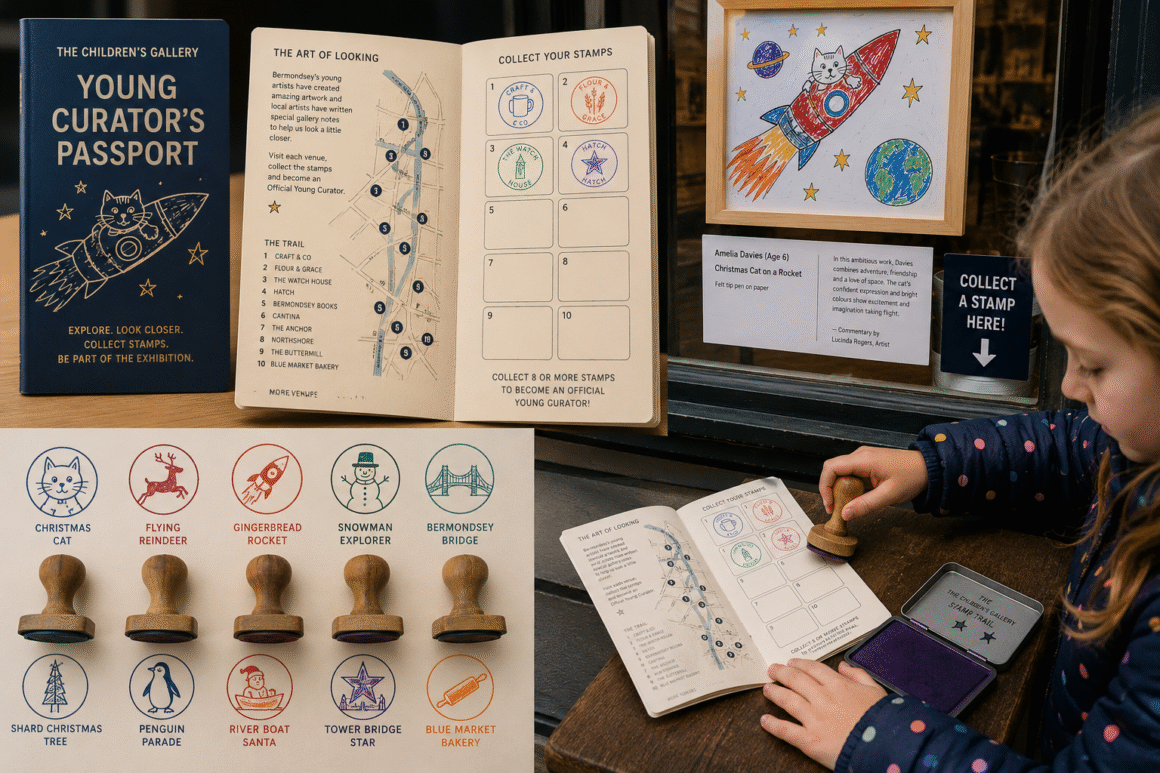
To encourage families to explore the exhibition, every participating child would receive a Young Curator’s Passport.
Part gallery guide, part treasure hunt and part keepsake, the passport would include a map of participating venues, featured artworks and space to collect stamps along the route.
Each participating business would host its own unique exhibition stamp. A child visiting a bakery might collect a gingerbread stamp. A café might offer a flying reindeer. A pub might host a Christmas cat. Every stop on the trail becomes a small discovery.
Imagine a family setting off on a Saturday afternoon with a folded passport in hand.
Their first stop is a café on Bermondsey Street where a drawing of Father Christmas arriving by speedboat hangs in the window.
Stamp number one.
Further along the route, they stop outside a local office displaying a picture of a Christmas tree balanced precariously on top of The Shard.
Stamp number four.
By the time they reach Pearl Yard they are comparing favourite artworks, debating which exhibition text made them laugh the most and searching for the next stamp on the map.
The passport transforms the exhibition from something people simply look at into something they actively participate in.
Importantly, it is not about prizes.
The aim is not to encourage children to collect things for the sake of collecting them.
The aim is to invite them to become curators.
Children who complete part or all of the trail could receive an Official Young Curator certificate, recognising the time they have spent exploring, observing and engaging with the exhibition.
After all, if the children are the artists, perhaps the visitors should be the curators.
Like the exhibition itself, the passport encourages something increasingly rare: taking time to stop, look closely and pay attention.
Get involved: Ben@Bermondsey.London