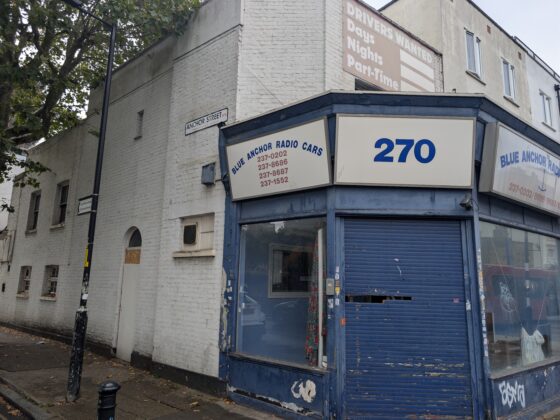
Following our call for ideas for vacant spaces in Blue Bermondsey, artist, architect and designer Giles Tettey Nartey has put forward a proposition: could one of Southwark Park Road’s empty shopfronts become a working studio, project space and place of exchange with the neighbourhood?

When we asked people to send us ideas for vacant spaces, this was exactly the sort of proposition we hoped the process might uncover.
Not a finished regeneration scheme or a fifty-page business plan, but a clear idea for how an otherwise closed commercial unit could become productive again.
The proposition is relatively simple.
Take an empty shop and turn it into a working studio.
But it also opens up a larger question.
What kinds of activity should a contemporary high street make room for?
A working studio
Giles Tettey Nartey is an artist, architect and designer whose practice spans furniture, installation, film and performance. Working between design, making and research, his projects have been exhibited at the V&A, Triennale Milano, Frieze and RIBA.
His proposal for Southwark Park Road begins with a practical need: a place in which to work, develop projects, make objects, meet collaborators and conduct research.
The studio would therefore have a genuine day-to-day function.
Most of the time, it would simply be a place where work is happening.
One of the questions behind our work on vacant units is whether the high street can accommodate forms of activity that sit outside the traditional definition of retail.
A workshop, studio, gallery, classroom or maker space may operate differently from a conventional shop, but it can still create activity behind a shopfront and contribute to the everyday life of the street.
In Giles’s proposal, that working studio would also periodically open itself to the neighbourhood.

A studio that opens its doors
The proposal could include open studios, small exhibitions, workshops, talks, screenings and conversations.
Some might relate directly to Giles’s own practice. Others could create opportunities to work with local residents, young people, students, artists, designers and other organisations in the area.
For Giles, the proposition is also an opportunity to test what a contemporary neighbourhood studio might be: a space where production, research, exhibition and public activity coexist, and where some of the processes normally hidden behind the finished cultural object become visible from the street.
As Giles explains:
“My aim would be to establish a working studio that has a meaningful relationship with the neighbourhood: a place for making and research that can periodically open itself through exhibitions, workshops, conversations and collaborations.”
The distinction is important.
The proposal is not for an installation designed simply to make an empty shop appear occupied.
The space would be used.
Objects would be made there. Projects would be developed there. People would come to work, meet and collaborate there.
Then, at particular moments, the doors could open.
An exhibition takes place.
A workshop happens.
A film is screened.
A conversation begins.
Someone who has walked past the shopfront dozens of times suddenly has a reason to enter.
What could a neighbourhood studio contribute?
There is a broader proposition behind the idea.
Cultural production is often removed from everyday public life. Artists and designers work in studios hidden inside industrial estates, warehouses, institutions or private buildings. The public encounters the finished work later, usually somewhere else.
A high-street studio creates a different relationship between production and public space.
Making becomes part of the everyday life of the street.
For someone walking along Southwark Park Road, the shopfront might reveal drawings pinned to a wall, furniture being assembled, a film being edited, a conversation taking place or an exhibition being installed.
The intention is not for the studio to operate as a permanent public venue.
Its primary purpose would remain the production of work.
Its public programme could instead be occasional and deliberate: a small number of moments throughout the year when the studio changes character and becomes a space for gathering, learning, exhibition or exchange.
That creates a model somewhere between the private studio and the conventional cultural institution.
It could also allow cultural activity to exist alongside the shops, cafés, services and businesses that already form the everyday infrastructure of the high street.
A different kind of cultural infrastructure
This is perhaps where the proposal becomes most interesting.
The question is not simply whether an artist can use an empty shop.
It is whether vacant commercial spaces can temporarily support a different form of local cultural infrastructure.
A studio of this kind could accommodate several activities within the same space: production, research, education, exhibition and public programming.
Rather than separating these functions into different buildings and institutions, they could overlap.
The model could remain relatively modest.
Most days, it is a studio.
Several times a year, it becomes something else.
An open studio.
A workshop.
A small exhibition.
A lecture.
A screening.
A gathering.
The value lies partly in this ability to change.
It allows a space to remain productive without requiring it to behave like a conventional shop every day of the week.
Could this become a pilot?
The next step is therefore to explore whether one of the currently vacant units could become a pilot for this model, and what Southwark Council, property owners, Blue Bermondsey and other local partners would need to put in place to make that possible.
That could mean looking at a peppercorn or substantially reduced meanwhile rent.
It could mean understanding how business rates, utilities and insurance would work.
It could involve a basic fit-out that makes an empty commercial unit usable as a studio.
It could also mean establishing clear permission for occasional exhibitions, workshops and public events, alongside a reasonable period of occupation and notice if the unit eventually returns to permanent commercial use.
There may also be a question of whether modest support for fit-out or public programming could help test the model properly.
None of these questions needs to be solved before the proposition can be discussed.
In fact, identifying them is part of the value of the exercise.
If we want to understand what prevents vacant high-street spaces from being occupied by useful temporary activity, then a concrete proposal gives us something against which to test the existing system.
Culture as part of the high street
Culture, making and creative work can sit alongside the everyday commercial and social uses that make a high street useful.
The strongest local streets tend to accommodate many different kinds of activity.
Some spaces sell things.
Some provide services.
Some feed people.
Some allow people to gather.
Others produce things.
Giles’s proposal asks whether a working cultural space could become another part of that mix.
Most of the time, the answer would be very ordinary.
Someone would be inside working.
Lights would be on.
Things would be being made.
Then occasionally the doors would open.
Something would be exhibited.
People would gather.
A workshop would take place.
The relationship between the studio and the street would change for an afternoon or an evening before returning to its everyday working life.
That is a relatively small proposition.
But it offers a useful question for Southwark Park Road:
What happens when we treat an empty shop not simply as a vacancy waiting to be filled, but as a space in which another kind of local institution might temporarily take shape?
Who is Giles Tettey Nartey?
Giles Tettey Nartey is an artist, architect and designer whose practice moves across furniture, installation, film, performance and research, exploring relationships between material, ritual, culture and making.
His work has been exhibited internationally and featured by Wallpaper, Dezeen, ICON and House & Garden.
You can see more of his work here:
- Wallpaper: Giles Tettey Nartey profile
- Wallpaper: AHEC Class of 24
- Dezeen Awards: Giles Tettey Nartey
- ICON: Craft and Ritual
- House & Garden: Rising Stars
One proposition among many
We wanted to share Giles’s proposal because it demonstrates why we began asking people what they might actually do with vacant spaces.
We could determine in advance that one unit should become a shop, another a café and another whatever type of business currently appears most frequently in regeneration strategies.
Or we can begin with propositions.
Some might involve retail.
Others might involve food, workshops, services, entertainment, making, community activity or entirely different uses.
Giles’s proposal offers one possible model.
The interesting question now is whether it can be tested.
The next step is to explore whether one of Blue Bermondsey’s vacant units could provide the setting for that experiment, and what would need to happen to turn the proposition into a working space.
Have an idea for an empty space in Blue Bermondsey?
Tell us about it → ben@bermondsey.london